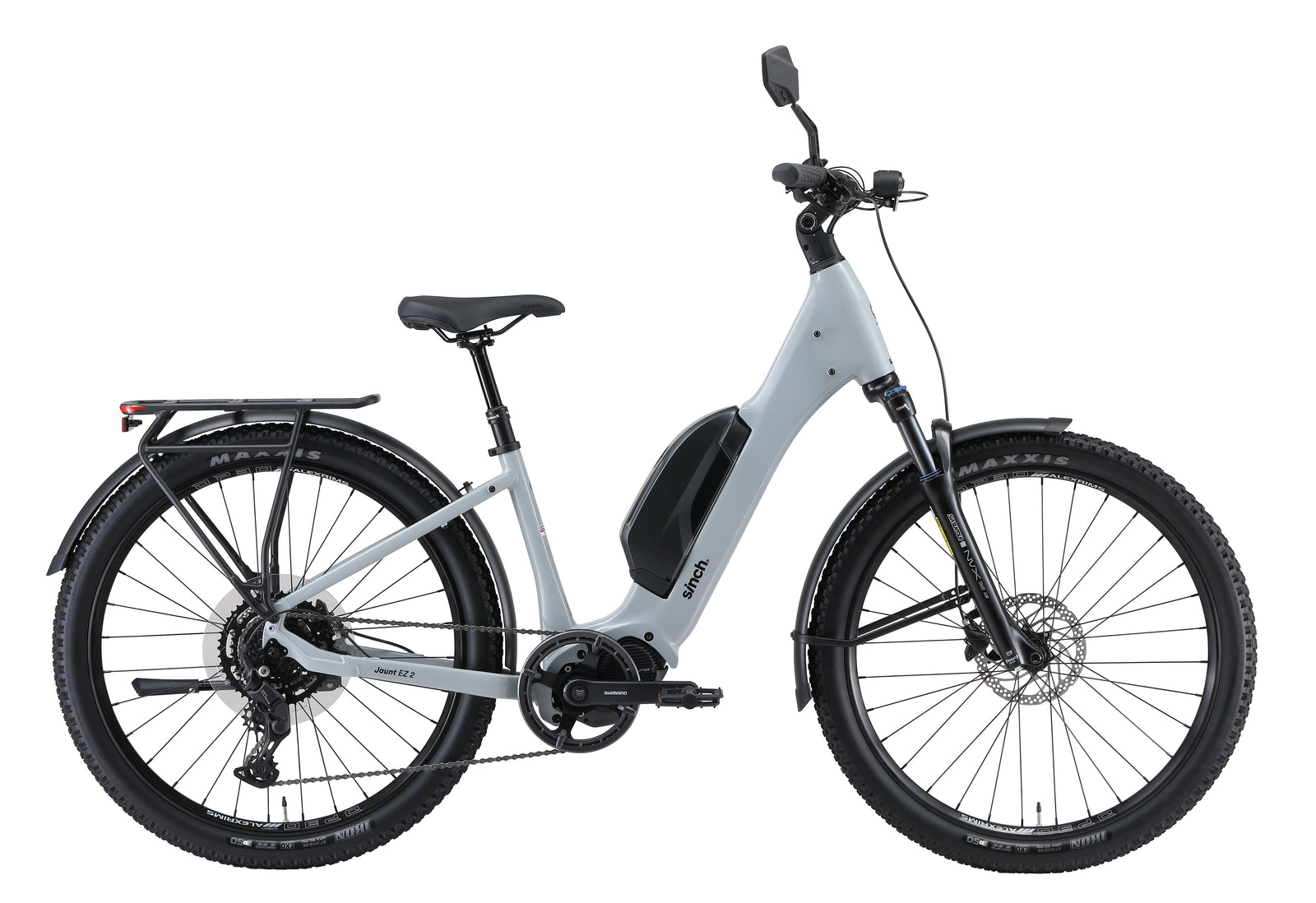
New Sinch Jaunt EZ 1 & EZ 2: Which Commuter E-Bike Is Right for You?
Aotearoa’s very own Sinch Bikes have done it again. The latest Jaunt EZ 1 and Jaunt EZ 2 are powerful, affordable e-bikes built around a familiar New Zealand brief: get to work, carry the shopping, deal with the hills and head out for a trail ride when the weekend allows.
Good, honest commuter bikes. The money goes into useful equipment and components that suit regular riding. And this release brings something particularly welcome: an XS step-through option for smaller riders who have spent too long trying to make a bigger bike fit.
The Jaunt EZ 1 costs $4,399.99. The Jaunt EZ 2 costs $5,299.99. Here’s what they share, who they suit, and when that extra $900 makes sense.
Who are these bikes for?
Think everyday riders: someone swapping a few car trips for bike trips, returning to cycling, or wanting to arrive at work without spending all their energy getting there. The step-through frame is useful at every stop, particularly with a bag on the rear carrier. You can get on without swinging a leg over your luggage.
They also make sense for riders whose week includes sealed roads, gravel paths and easy cycle trails. Their upright riding position and front suspension suit that mix. Technical mountain-bike trails are a different job.
An XS step-through: a proper option for smaller riders
For the first time, our Jaunt EZ range starts at XS. Sinch’s guide puts that size at roughly 148–156 cm rider height, followed by S/M at 154–170 cm and M/L at 168–180 cm. We have all three sizes listed in both models.
A low frame is only part of getting the fit right. You also need a comfortable reach to the handlebars, a usable saddle height and confidence when starting and stopping. Simply lowering the saddle on an oversized bike doesn’t solve all of that.
If you’ve repeatedly been told that a bike is “the smallest we do”, these are worth trying. The XS opens the door to a much better fit; a test ride will tell us whether it works for your proportions. On the EZ 2, the dropper seatpost adds another useful trick: lower the saddle to make stopping easier, then return it to pedalling height.

Both get the same motor and 45 km/h assistance
Both bikes use Shimano’s EP600 motor, delivering 85 Nm of torque. Buying the EZ 1 doesn’t mean accepting a weaker motor. The EZ 2’s extra cost goes into battery capacity and other equipment.
Assistance continues up to 45 km/h on both. If you’ve ridden an e-bike that stops helping at 32 km/h, you may know the feeling: you reach a comfortable pace on an open stretch, the assistance fades away, and maintaining that pace suddenly asks more of your legs. The bike can still go faster, but you’re supplying the effort.
A higher assistance ceiling gives you more room to choose a comfortable cruising pace where the route and conditions allow. That can be useful on a longer commute, with fewer interruptions to your rhythm around the 32 km/h mark. It doesn’t promise a 45 km/h average, and faster riding uses more battery.
On shared paths, ride to the people and conditions around you. Slow down for walkers, dogs, junctions and limited visibility. Having assistance available at a higher speed is useful; there’s no need to use it everywhere.
CUES: gearing built for regular e-bike use
Both use Shimano CUES nine-speed gearing with LINKGLIDE. An e-bike’s chain and cassette have to handle the rider’s effort plus the motor’s, often day after day on the same commute.
Shimano’s LINKGLIDE design uses more substantial cassette teeth and revised shifting surfaces to improve wear resistance and reduce the jolt between gears. It’s a sensible priority for a working bike: consistent shifting and durability under motor-assisted loads.
There’s still a chain to clean, lubricate and eventually replace. CUES gives you a drivetrain designed with that everyday workload in mind.
The finer details that matter on a commuter
Both models have an SR Suntour NVX32 AIR fork with 80 mm of travel, rebound adjustment and lockout. An air spring can be set for the rider’s weight, particularly useful for smaller riders who can struggle to get much movement from a stiff, fixed-rate coil fork.
The black stanchions are the sliding tubes above the fork’s lower legs. Around Wellington’s wet roads and coastal spray, keeping those surfaces and the seals clean is a worthwhile habit. The finish alone isn’t a substitute for care or servicing.
Shimano hydraulic disc brakes, mudguards, integrated lights, a mirror and a kickstand are fitted to both bikes. Their MIK HD rear carriers are rated to 27 kg, and the rear lights include a brake-sensing function. These are practical things you’d otherwise be adding to make a bike ready for daily use.
Jaunt EZ 1 vs EZ 2: what does $900 buy?
| Detail | Jaunt EZ 1 | Jaunt EZ 2 |
|---|---|---|
| Price, NZD | $4,399.99 | $5,299.99 |
| Motor / assistance | EP600, 85 Nm / up to 45 km/h | EP600, 85 Nm / up to 45 km/h |
| Removable battery | 504 Wh | 630 Wh |
| Nine-speed cassette | 11–41T | 11–46T |
| Seatpost | Conventional alloy | Dropper |
| Tyres | CST All Terrains | Maxxis Ikon, EXO protection, tubeless ready |
| Display | Compact SC-EN500 | Colour SC-EN610 with separate switch |
| Colour | Matte Tasman Drift | Southern Mist |
The biggest difference is the battery: 630 Wh is 25% more stored energy than 504 Wh. That gives the EZ 2 more capacity for the same ride, although actual range still depends on hills, wind, rider and luggage weight, assistance level and speed.
The EZ 2 also gets a lower climbing gear. Both use a 44-tooth front chainring, but the EZ 2’s larger 46-tooth rear sprocket makes its lowest gear easier to turn than the EZ 1’s 41-tooth option. That matters when the final part of your commute climbs away from the harbour, especially with bags aboard.
Add the dropper post, upgraded tyres and colour display, and the extra money buys several changes you can put to work. Tubeless-ready tyres describe compatibility; they don’t mean the bike is supplied set up without tubes.

Why we’d choose the EZ 2 for a Hutt Valley commute
Te Ara Tupua now connects Wellington and Lower Hutt with a new walking and cycling route. For anyone considering a regular ride between the city and the Hutt Valley, the EZ 2 is the one we’d lean towards.
A longer return journey, a headwind along the harbour and a climb at either end can all add to the day’s battery demand. The larger battery gives you more margin. The lower climbing gear helps when the route turns uphill, and the dropper is useful when a longer open stretch gives way to frequent stops.
We wouldn’t attach a guaranteed kilometre range to it without knowing your route and how you ride. Tell us where you’re starting, where you work and whether you can charge at either end. That’s a better way to choose a battery than a best-case range figure.
Which would we put you on?
Choose the EZ 1 if your main jobs are local trips and a shorter commute, you can charge conveniently, and keeping the purchase price down matters. You get the same motor, assistance ceiling and core commuter equipment. There’s a lot to like about keeping $900 in your pocket when you don’t need the upgrades.
Choose the EZ 2 if you’re planning longer commuting days, carrying bags up hills, or mixing weekday transport with regular trail outings. Its larger battery, lower gearing and dropper post make a persuasive package for that use.
And if fit has always been the sticking point, come and try the XS. Start with the bike that fits, then work out which specification suits your riding. We’ll help you compare the two at Bicycle Junction.
See the Jaunt EZ 1 and full specifications · See the Jaunt EZ 2 and full specifications
Prices are NZD and correct at publication. Manufacturer details: Sinch Jaunt EZ 1 and Sinch Jaunt EZ 2.